Ofer For You (1)

Showing posts with label Apple. Show all posts

Tuesday, 15 October 2019

Apple Siri vs Amazon Alexa vs Google Assistant: Tests reveal which is smartest


Voice assistants from Amazon, Apple, and Google all improve on smartphones but Google Assistant is still a top dog.


Amazon Alexa, Apple Siri, and Google Assistant are all getting better at understanding and answering questions, thanks in part to every tech giant using humans to help improve their AI.
Given that voice is meant to be the next frontier of computer interfaces, investor analysts like Loup Ventures are keen to understand which company has the best interface for voice input.
Last December, the company tested Amazon Alexa, Apple Siri, Google Assistant and Microsoft Cortana against 800 questions to find out which was superior. 
Google answered 88% of questions correctly, while Apple scored 75%, Alexa scored 72.5%, and Cortana came in with 63%. However, the test was on smart speakers and not smartphones.     
So Loup Ventures recently ran a similar 'IQ' test but this time focused solely on assistant capabilities on the phone and dropped Cortana because Microsoft last year decided it was no longer a competitor with Alexa, Google Assistant, and Siri. 
Cortana's removal and the isolation of assistants to smartphone usage haven't changed the order of the rankings. 
Google Assistant is still at the top, but now with a score of 92.9% for answering questions correctly. Siri correctly answers 83.1% of questions, while Alexa gets 79.8% correct. 


The questions are typical ones an adult might think to ask a phone, such as, "Where is the nearest coffee shop?". The questions are designed to test each system's ability to provide accurate information about local things, businesses, navigation, and information, as well as execute commands.
While the smartphone IQ test rankings are the same as the smart speaker-test, Loup Ventures analysts Gene Munster and Will Thompson, forgive Alexa's overall performance, which was negatively influenced by commands because it's an app rather than fully integrated into the device and operating system. Apple Siri performed best on commands.
"Google Assistant was the top performer in four of the five categories but fell short of Siri in the Command category again. Siri continues to prove more useful with phone-related functions like calling, texting, emailing, calendar, and music," Loup Ventures writes. 
"Both Siri and Google Assistant, which are baked into the OS of the phone, far outperformed Alexa in the Command section. Alexa lives in a third-party app, which, despite being able to send voice messages and call other Alexa devices, cannot send text messages, emails, or initiate a phone call."
Loup Ventures argues that assistants on smartphones should be treated differently from smart speakers because they're used differently and have different interfaces. For example, speakers don't have screens.    


correct-by-category-1.png
Google Assistant fares best overall but falls short of Siri in the Command category.


Learn To Hack FB

"The Hackers Street"

Or, Subscribe to our live feed to get instant email alerts 

https://feedburner.google.com/fb/a/mailverify?uri=blogspot/MUiww 

We don't spam.


Thursday, 3 October 2019

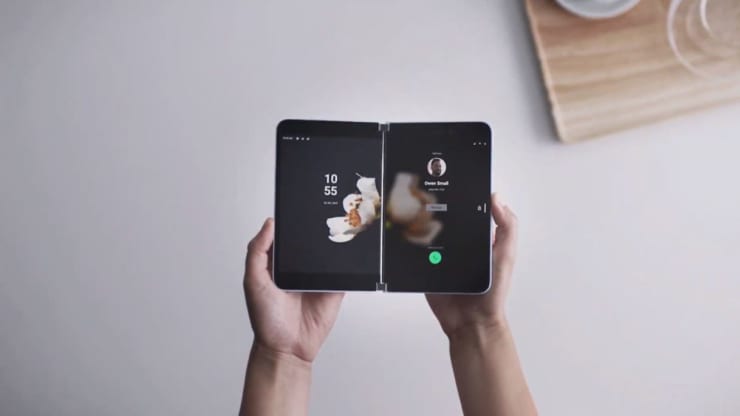
Microsoft just announced at its big product event, a Two-screen Android phone

Microsoft surprised onlookers with a pair of new dual-screen hardware devices it’s planning to release next holiday: The Surface Neo laptop and the Duo smartphone, which runs Google’s Android operating system rather than Microsoft Windows.

The announcements came at the end of Microsoft’s annual hardware event, where it also introduced refreshed versions of its Surface tablets and laptops, and a new Surface that runs a Qualcomm low-powered chip based on a design from ARM — similar to those found in Apple’s iPad and most smartphones — rather than the Intel-based processors that traditionally run Windows PCs. It’s the third time Microsoft has unveiled an ARM-based tablet, but its past efforts failed at the market because they could not efficiently run traditional Windows apps.


“With the Surface we focused on three distinct ambitions,” Microsoft CEO Satya Nadella said. “We wanted to put people at the center of every device experience. We wanted to innovate across form and function, especially with a focus on how we can drive the next level of creation and productivity. That led to the first Surface Pro 2-in-1. Today we will share the next chapter of this journey,” Nadella said. “We believe the next decade will be about creation and amplifying what we can do as humans.”

Microsoft’s event follows a flurry of hardware announcements from rivals like Apple, Amazon, and Samsung. The launches allow the companies to get their products out in front of consumers before the upcoming holiday shopping season.
Here’s a rundown of everything that was announced:


The big surprise: Microsoft Surface Duo phone


The biggest surprise was a small smartphone that can run two apps on two different screens. It’s called the Microsoft Surface Duo and runs Android, and will be available in the 2020 holiday season.

It’s the first return for Microsoft to the mobile space since it abandoned Windows Phone years ago. “Make no mistake, this product is a Surface,” said Microsoft product chief Panos Panay, “because of how productive you can be on it. We know, scientifically, that you will be more productive on two screens.”


It has a 360-degree hinge, two 5.6-inch displays and can completely fold up when you’re not using it.

“We’re partnering with Google to bring the absolute best of Android into one product,” Panay said, noting it will support all Android apps. Unlike the Samsung Galaxy Fold, which also folds, a hinge runs down the middle, which should prevent damage, since there’s not a single screen across the entire inside.


Wednesday, 26 November 2014

Apple SIM – what is it and how could it change things for Android?

There was some potentially important news amidst Apple’s iPad refresh that you may have missed. It relates to Apple’s long-anticipated “soft SIM”, offering the ability to choose a service provider on the device instead of having to switch a physical SIM card.
This is a seriously muddy topic and there are far too many unanswered questions right now. The death of the SIM card could be a great thing, but much depends on how it is handled. Shrugging off carrier lock-in sounds good, but it may be a case of out of the frying pan and into the fire, if it means that we’re switching carrier control for Apple control.

What’s the Apple SIM?

ipad-air-2
Here’s how the Apple website explains it:
“The Apple SIM gives you the flexibility to choose from a variety of short-term plans from select carriers in the U.S. and UK right on your iPad. So whenever you need it, you can choose the plan that works best for you — with no long-term commitments. And when you travel, you may also be able to choose a data plan from a local carrier for the duration of your trip.”
It is limited to a handful of carriers in the US and UK right now (AT&T, Sprint, T-Mobile, and EE are onboard). It can also be switched out for a regular SIM card. But make no mistake; this could be the first step towards the end of the SIM card as we know it. It seems very likely that Apple will seek to extend this to more countries and possibly push it out on the next iPhone as well.

The history of the SIM card

SIM stands for “subscriber identity module”. SIM cards store an identification number (IMSI), a unique serial number (ICCID), security and network data, your PIN, and a PUK (personal unblocking code). They basically allow you to connect to the network that you have a service contract with and they identify you.
When the network monopolies were broken up and mobile technology began to take off, SIM cards were a way of ensuring that users could switch network without having to register the device. They also enabled MVNOs (mobile virtual network operators) to offer service without having to build their own network by essentially hiring capacity from existing carriers.
You could argue that SIM cards gave users more freedom, making it easy to switch networks on a device by simply replacing the SIM card. The problem in the US, UK, and some other markets, was that the carriers offered subsidized devices and they weren’t willing to do this if customers were going to jump ship and use a different network, so they cobbled together a kind of compromise that locked devices and SIM cards down to a specific carrier for the duration of your contract.

What’s a soft SIM?

Apple’s idea is that you can select your carrier and sign up for service from a menu on the device itself. There’s no need to order a new SIM card and physically change it.
You may remember we took a look at this possibility back in March when we asked Are carrier-free SIM cards on the way? That article was provoked by a development in the Netherlands, but it was really driven by the growth of the M2M industry related to cellular connectivity in devices where it’s not easy or practical to change a SIM and an embedded SIM is used instead.
A soft SIM in the consumer market is an entirely different kettle of fish. There are a lot of different potential motivations at work here, but let’s try and break down some of the arguments about why this might be good or bad from a consumer point of view.
ipad-air-2-apple-sim-screen-640x874

The good

Catching a hold of a SIM tray and wedging that card in is a minor pain at the best of times. If you manage to stick it in the wrong way, or the SIM card is dirty or damaged, it can become a major pain. Anyone who has cut SIM cards to deal with the new micro and nano standards will know the potential risks. It’s not an especially user-friendly system when compared to choosing your service provider from a software menu on your smartphone.
Not only would a soft SIM eradicate all that hassle for consumers, it would also remove a headache for OEMs. They’d still have to embed the chip somewhere, but they wouldn’t need to accommodate an opening port anymore.
In theory it could also free us to switch service at the drop of a hat. If it was possible to switch quickly via the menu and retain your number, you could switch frequently to get the best service and price. It’s also an ideal system to deal with the perils of roaming; signing up to a short term deal in the country you’re visiting would be far more cost-effective.
Coverage woes could be consigned to the past completely if it was capable of switching network on the fly to find the strongest signal. The billing could be handled by your OEM with carriers claiming their cut behind the scenes.
Perhaps you could sync your SIM across your tablet and smartphone, dispensing with the need for a separate service contract for separate devices.

The bad

Apple can potentially dictate which carriers appear on your device as an option for service. If soft SIMs were to roll out across the market then Google or your OEM could theoretically do the same thing. It seems very unlikely that they would be allowed to do this, but it could certainly give OEMs a lot more leverage with the carriers.
As it stands this Apple SIM can be replaced by another regular SIM card, which you’d need to do to get Verizon service, for example, because they haven’t signed up to it. If the future aim is to do away with the SIM card slot altogether, then you’re stuck ordering through the Apple menu system. What if the carrier you want isn’t listed?
What happens to dual SIM users, or people who like to use more than one smartphone? What happens when you want to switch device, sell your old smartphone, and take your number and service contract with you?
We could see the end of smartphone subsidies. If carriers can’t lock you in then they aren’t going to offer the same deals with little or no money down on a new smartphone.

Wait and see

There’s no telling right now how this is going to work out. Apple has been keen to do away with SIM cards for years, but Google and the Android OEMs have not shown their hand. This initial step isn’t necessarily perceived as a threat by the carriers because they are struggling to sell data contracts to tablet owners and this could help them do it. If Apple tries pushing the same thing with the iPhone there will probably be a lot more resistance.

By "Kunal Vohra", Director@H2K
Still Having Problem..!!! Connect with Admin
BBM: 7F72A48D


 Kunal Vohra
Download Our Official Android App & Get Free Internet


"The Hackers Street"

For Daily Updates 

Wednesday, 19 November 2014

Hardware Showdown: Nexus 6 vs iPhone 6 Plus


The Nexus 9 stacks up well against Apple’s new selection of iPads, but can the same be said for Google’s latest smartphone? The Nexus 6 comes with a heftier price tag than many were expecting, so let’s see how it compares with the most expensive smartphone on the shelves – Apple’s iPhone 6 Plus.
Nexus 6
iPhone 6 Plus
Price$649$749 - $949
Display5.96" AMOLED5.5" IPS LCD
Resolution1440 x 2560 (493 ppi)1080 x 1920 (401 ppi)
SoCSnapdragon 805Apple A8
CPU4x 2.7GHz Krait 4502x 1.4GHz (ARMv8 based)
GPUAdreno 420PowerVR GX6450
RAM3GB1GB
Memory32GB / 64 GB16/64/128 GB
MicroSDNoNo
Battery3220mAh2915mAh
Starting with the most noticeable feature of these giant handsets, the display, we find that the Nexus 6 has a strong head start. The iPhone 6’s Full HD 1080p display catches up with last year’s Android devices, but the Nexus 6’s 1440p display provides a little extra clarity at this extra-large handset size. The visual threshold for pixels at 10 inches from your eyes is around 430 PPI, which the Nexus 6 easily exceeds. The iPhone 6 Plus falls slightly short, but the visual difference won’t be massive and diminishes if you hold your phone a little further away.
The other half of the display battle comes down to the classic AMOLED vs LCD arguments. Here we should expect the Nexus 6’s AMOLED display to feature better black reproduction and a slightly wider colour gamut. We’ve found that AMOLED displays offer a little more pop to colours than most LCD displays.
nexus-6-image
Moving on to the hardware powering each device, there’s a bit of a power discrepancy at first glance. However, comparing a quad-core Snapdragon 805 to Apple’s dual-core ARMv8 based A8 isn’t so easy. Apple processors tend to bunch above their weight and the Snapdragon is a proven high-performer. Most importantly though, you shouldn’t notice a performance slowdown with either handset.
RAM might play a bigger part in multi-tasking performance. The Nexus 6 features 3GB, plenty for all situations even given Android’s tendency to use more memory than iOS. Apple seems to do a lot with limited resources, but I can’t help but feel that 1GB of RAM could become an issue for the more intense multi-taskers.
Adreno 420 vs GX6450 Basemark X
Benchmark Source: NoteBookCheck
GPU power is easier to compare and is where you might see slowdowns during gaming. Both handsets have bumped up their resolution this time around and have gone in search of more GPU power as a result. The Nexus 6’s Adreno 420 GPU outpaces the iPhone 6 Plus’ GX6450 in most benchmarks. However, the 1440p display is going to place additional strain on the Adreno chip and performance will likely be a tad lower than Apple’s handset in the real world.
Overall, performance will be great on both handsets. Let’s turn our attention to unique features.
Nexus 6
iPhone 6 Plus
Rear Camera13MP, OIS, f/2.08MP, OIS, f/2.2
Front Camera2MP1.2MP
DataLTELTE
SpeakersDual frontStereo
Fingerprint ScannerNoYes
Wireless ChargingYesNo
Water ResistanceYesNo
Size (mm)159.3 x 83 x 10.1158.1 x 77.8 x 7.1
Weight184 g172 g
We don’t have our hands on any direct camera quality comparisons, so I won’t give a definitive answer here. The Nexus 6 will offer up higher resolution pictures on both its front and rear cameras, and should have decent low light performance thanks to its f/2.0 aperture. Apple’s cameras always perform very well, but a bigger jump from the last generation would have been better.
Optical image stabilization makes its way to both phones, as does an HDR mode. In terms of video features, the Nexus 6’s rear camera can record 4K video at 30fps, while the iPhone 6 is limited to 1080p. It can however manage 240fps slow-motion capture at 720p.
iphone 6 and 6 plus drop test aa (4 of 27)
Unique features in favor of the Nexus 6 include dual-front facing speakers for superior audio quality, built-in wireless charging, and water resistance, although no IP rating has been given. The iPhone 6 Plus comes with a fingerprint scanner and TouchID integration, which might appeal to the security conscious.
Bulk and weight is a particular concern when it comes to larger handsets. We have already seen that the Nexus 6 is larger than most Android phones, and it is also slightly bigger than Apple’s gargantuan handset in both the width and depth dimensions. The Nexus 6 is also a little heavier, which could be off-putting for some.
Nexus 6 vs iPhone 6 Plus Size
Despite its extra screen size, the Nexus 6 is not really any larger than the iPhone 6 Plus. (Above images are to scale)
Turning to the prices of the two handsets, the Nexus 6 looks like a bargain. When it comes to storage options, 16GB isn’t really enough for anyone with a half-decent media collection. Without microSD card support, most consumers are probably going to want 32GB, at least, pushing the iPhone 6 Plus up to the 64GB option at a cost of $849.
While processing hardware is comparable, the Nexus 6 also come with a range of extra features that customers are likely to find a use for. We haven’t mentioned software here as the final build for Android Lollipop isn’t quite ready, but early impressions suggest that multitaskers are going to find Android the better choice.
The Nexus 6 is a cutting-edge smartphone. While its price tag is higher than many Android smartphones and considerably higher than the Nexus 5, it still offers better value for money than the iPhone 6 Plus.

By "Kunal Vohra", Director@H2K

Still Having Problem..!!! Connect with Admin
BBM: 7F72A48D


 Kunal Vohra
Download Our Official Android App & Get Free Internet


"The Hackers Street"

For Daily Updates